Most patients have heard the term laser dentistry but have no idea what it actually means for their treatment experience. The short answer is that lasers replace or work alongside traditional dental tools for specific procedures, and the result is often less bleeding, less discomfort, and faster healing. Dr. Jamielynn Hanam-Jahr is a Doctor of Dental Surgery, a member of the American Dental Association, and holds a Standard Laser Proficiency certification from the Academy of Laser Dentistry. She has offered laser-assisted treatment at Beverly Hills Aesthetic Dentistry since 2001.
Patients from Beverly Hills and Century City often ask about laser dentistry after reading about it or being told their gum tissue needs treatment. The concern is almost always the same: will this hurt more or less than what they have experienced before. The honest answer for most soft tissue and gum procedures is less. Knowing what laser dentistry does and which procedures use it helps patients make informed decisions before they sit in the chair.
What Is Laser Dentistry and How Does It Work?
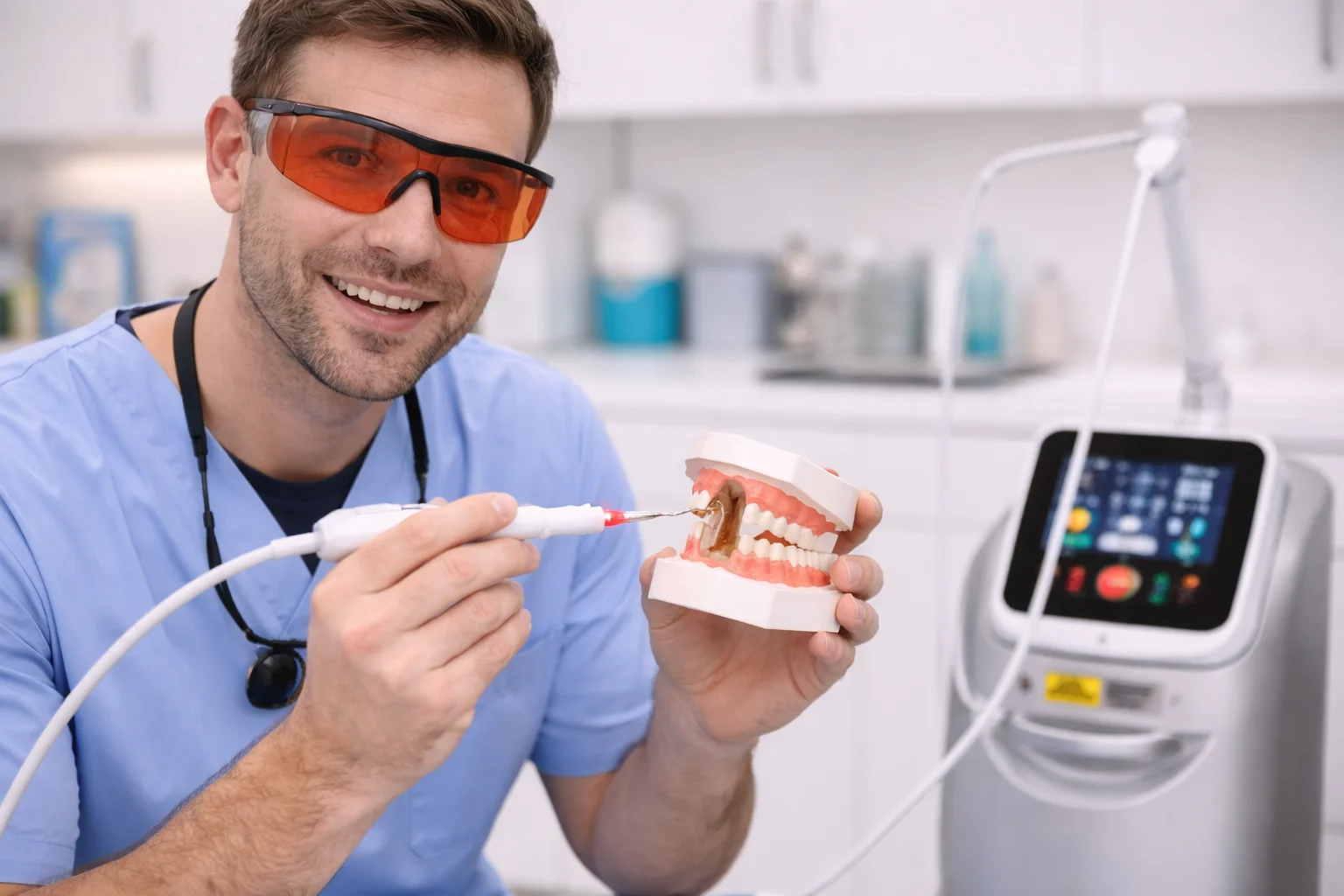
Laser dentistry uses focused beams of light energy to cut, reshape, or treat tissue with a level of precision that traditional metal instruments cannot match. The laser targets specific tissue while leaving the surrounding area largely undisturbed. This precision is what drives most of the clinical advantages patients notice: less trauma to surrounding tissue, less bleeding, and faster healing compared to scalpels or drills.
Two categories of lasers are used in dentistry. Hard tissue lasers target tooth structure and can be used for cavity preparation and treating sensitivity. Soft tissue lasers target the gums and oral soft tissue and are the most common type used in general dental practices. Beverly Hills Aesthetic Dentistry uses soft tissue laser technology across several procedures, and Dr. Hanam-Jahr holds a formal certification in its clinical use.
Which Dental Procedures Use Lasers in Beverly Hills?
Laser technology is not used for every procedure, but it is well suited for a specific set of treatments where precision and minimal tissue trauma matter most. Knowing which procedures use it helps patients understand what to expect when their treatment plan includes a laser. Here are the procedures most commonly performed with laser assistance at Beverly Hills Aesthetic Dentistry.
- Gum contouring and reshaping for cosmetic and functional results
- Crown lengthening to expose more tooth structure before a restoration
- Treatment of gum disease through removal of infected tissue
- Frenectomy, the removal of restrictive tissue connecting the lip or tongue
- Gingival troughing to create clean margins before crown impressions
- Soft tissue biopsy and removal of minor lesions
- Exposure of partially erupted teeth
Each of these procedures benefits from the laser’s ability to cut and seal tissue at the same time. That sealing effect is what reduces bleeding during treatment and speeds up recovery afterward.
How Does Laser Dentistry Compare to Traditional Tools?
The most meaningful difference patients notice is the recovery. Traditional scalpel procedures on gum tissue typically involve sutures, significant swelling, and several days of restricted diet. Laser procedures on the same tissue often require no sutures, produce minimal swelling, and allow patients to return to normal activity much faster. That difference matters most to Beverly Hills patients with demanding schedules.
| Feature | Traditional Instruments | Laser Dentistry |
| Bleeding during procedure | More common | Significantly reduced |
| Sutures needed | Often required for soft tissue | Rarely required |
| Post-procedure swelling | Common for 2 to 5 days | Minimal in most cases |
| Anesthesia required | Almost always | Sometimes reduced or eliminated |
| Sterilization of treatment area | Mechanical only | Laser also sterilizes as it works |
| Recovery time | Several days to one week | One to three days for most procedures |
This comparison reflects general outcomes for soft tissue procedures. Hard tissue laser procedures for cavities and sensitivity carry their own specific benefits. Recovery times vary by individual case and procedure complexity. Dr. Hanam-Jahr reviews the expected outcome for your specific procedure before treatment begins.
Why Does Laser Dentistry Cause Less Discomfort?
The reduced discomfort comes down to how the laser interacts with tissue compared to a blade or drill. A scalpel cuts tissue mechanically, which triggers an inflammatory response as the body repairs the wound edges. A laser vaporizes tissue with light energy, which simultaneously seals blood vessels and nerve endings in the treated area. That sealing effect is what reduces both the bleeding you see during treatment and the throbbing sensation that follows.
Research published in a peer-reviewed study on laser-assisted interdisciplinary dental treatment found that laser application enhances tissue healing and improves procedural precision across periodontal, endodontic, and prosthodontic procedures. The precision of the laser also means less collateral trauma to healthy tissue surrounding the treatment site, which is another reason recovery tends to be shorter.
Who Is a Good Candidate for Laser Dentistry in Beverly Hills?
Laser dentistry is appropriate for most patients who need soft tissue procedures, but it is not a universal replacement for every dental tool. Patients with metal amalgam fillings cannot always receive certain hard tissue laser treatments, and some complex procedures still require traditional instruments alongside the laser. The right way to think about it is as a precision tool Dr. Hanam-Jahr selects when it produces a better outcome than the alternative.
Patients who are particularly good candidates include those with dental anxiety who want to minimize the sounds and sensations associated with traditional treatment, patients who need gum work before cosmetic procedures like veneers or crowns, and patients managing gum disease who want a less invasive approach to infected tissue removal. Here are the situations where laser treatment is most commonly the right choice.
- Patients needing gum reshaping before cosmetic work such as porcelain veneers or crowns
- Patients with active gum disease who want minimally invasive infected tissue removal
- Patients who have frenulum attachments causing discomfort or speech issues
- Patients who want gum contouring as part of a smile makeover
- Patients with dental anxiety who want to reduce the sensory experience of treatment
Dr. Hanam-Jahr evaluates each case individually. The goal is always the best clinical outcome for your specific situation, not a preference for one tool over another.
Is Laser Dentistry Available in Beverly Hills CA?
Yes. Beverly Hills Aesthetic Dentistry offers laser-assisted treatment as part of its standard care. Dr. Hanam-Jahr completed her laser training through the Academy of Laser Dentistry, which sets the clinical education and safety standards for laser use in dental practices across the country. Fewer than 5 percent of general dentists in the United States hold a formal laser proficiency certification from the Academy of Laser Dentistry. That training matters because using the wrong laser wavelength or power level on tissue can cause damage, and certification ensures the provider understands how to calibrate treatment safely for each procedure.
The availability of laser treatment at Beverly Hills Aesthetic Dentistry means patients who need gum work, cosmetic tissue reshaping, or minimally invasive gum disease treatment do not have to be referred elsewhere. That care happens in the same practice where the rest of their treatment is planned and delivered.
What to Do If You Think Laser Dentistry Might Be Right for You
Patients who have been told they need gum treatment, crown lengthening, or soft tissue work and want to understand all their options are in the right position to ask about laser dentistry at the consultation. The question is not whether you want a laser or a scalpel. The question is which approach gives you the best outcome with the least disruption to your schedule and your comfort. Whether you are in Beverly Hills, Bel Air, or West Hollywood, that conversation starts at Beverly Hills Aesthetic Dentistry.
Dr. Jamielynn Hanam-Jahr, a Doctor of Dental Surgery, ADA member, and Academy of Laser Dentistry certified provider, has been treating patients at Beverly Hills Aesthetic Dentistry since 2001. If you need gum work, cosmetic tissue reshaping, or minimally invasive treatment for gum disease, call (310) 276-2088 to schedule a consultation. The right tool for your procedure is whatever produces the best outcome for you.
Beverly Hills Aesthetic Dentistry 435 N Bedford Dr #414, Beverly Hills, CA 90210 (310) 276-2088 https://mybeverlyhillsdentist.com
Frequently Asked Questions
What is laser dentistry and how is it different from traditional dental treatment?
Laser dentistry uses focused light energy to cut, reshape, or treat oral tissue instead of mechanical instruments like scalpels or drills. The laser seals blood vessels and nerve endings as it works, which is why most patients experience less bleeding and less post-procedure discomfort than they would with a blade. Healthline notes that laser dentistry also reduces the chance of bacterial infection because the laser sterilizes the treatment area as it works. Not every procedure can use a laser, but for soft tissue and gum treatment it is often the more comfortable and precise option.
Does laser dentistry hurt less than traditional dental procedures?
For most soft tissue procedures, patients report significantly less discomfort with laser treatment than with a scalpel. The Academy of Laser Dentistry notes that laser treatment in dentistry reduces post-operative discomfort and supports faster healing by minimizing trauma to surrounding tissue. Whether anesthesia is still needed depends on the specific procedure and the patient’s individual sensitivity. Dr. Hanam-Jahr discusses what to expect for your exact procedure before treatment begins so there are no surprises on the day.
How much faster does healing happen with laser dentistry?
Healing times vary by procedure, but soft tissue laser procedures typically allow patients to return to normal activity within one to three days compared to several days to a week for traditional scalpel procedures. A study on laser-assisted dental treatment outcomes found that laser application enhances tissue healing and reduces post-operative pain at both one hour and twenty-four hours after treatment compared to conventional surgery. The reduced bleeding during the procedure is one of the main reasons recovery is faster. Less tissue trauma at the point of treatment means the healing process starts from a better baseline.
Does Dr. Hanam-Jahr have formal training in laser dentistry?
Yes. Dr. Hanam-Jahr holds a Standard Laser Proficiency certification from the Academy of Laser Dentistry, which is the professional organization that sets clinical education and safety standards for laser use in dental practices. The Academy of Laser Dentistry notes that certification in laser dentistry requires demonstrated knowledge of laser-tissue interactions, wavelength selection, and safety protocols, not simply ownership of a laser device. This matters because using the wrong settings on tissue can cause damage, and certification ensures the provider knows how to calibrate treatment safely for each specific procedure. Beverly Hills Aesthetic Dentistry offers laser-assisted care as part of its standard clinical services.