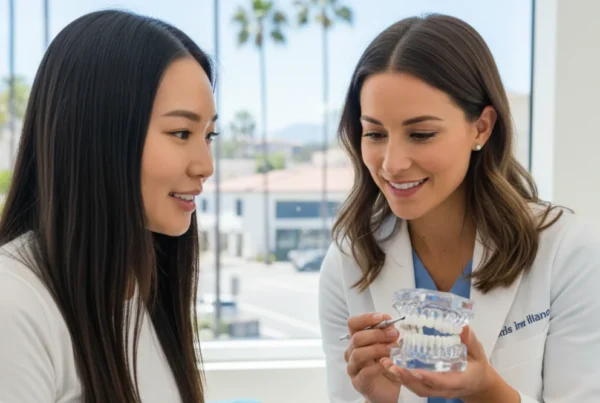

Invisalign can successfully treat many complex orthodontic cases when combined with expert planning and advanced techniques. Dr. Jamielynn Hanam-Jahr from Beverly Hills Aesthetic Dentistry, with her Doctor of Dental Surgery from Louisiana State University and over 20 years of experience, has seen significant advances in Invisalign’s capabilities for challenging cases.
Complex issues like severe crowding, bite problems, and tooth rotations can often be addressed through hybrid treatments combining Invisalign with traditional methods, precise digital planning, and specialized attachments. Success depends on accurate case assessment, patient compliance with 20-22 hour daily wear, and experienced orthodontic management. While severe jaw discrepancies may still require surgical intervention, most complex alignment issues can be effectively treated with modern Invisalign techniques and comprehensive treatment planning.
Exploring the Evolution of Complex Case Treatment
Invisalign has come a long way from its early days when it was primarily used for simple spacing and minor crowding issues. Today’s advanced Invisalign technology can address many complex orthodontic problems that were previously thought to require traditional braces exclusively.
The definition of “complex cases” in orthodontics encompasses severe crowding, significant spacing issues, complicated bite problems, substantial tooth rotations, and cases requiring multiple types of corrections simultaneously. These situations present unique challenges that test the limits of any orthodontic system, including Invisalign.
Modern Invisalign incorporates sophisticated attachments, power ridges, and precision cuts that enable more complex tooth movements than ever before. These innovations allow orthodontists to apply precise forces needed for challenging corrections while maintaining the aesthetic and comfort advantages of clear aligners.
The key to success with complex Invisalign cases lies in understanding when the technology is appropriate and when hybrid approaches or alternative treatments might serve patients better. Beverly Hills patients often seek the discretion of Invisalign even for complex cases, making proper evaluation and treatment planning crucial.
Understanding the Depth of Case Complexity
Orthodontic complexity exists on a spectrum, and understanding where your case falls helps determine whether Invisalign can effectively address your specific needs. Not all complex cases are created equal, and some respond better to clear aligner therapy than others.
Severe crowding presents unique challenges for any orthodontic treatment. When teeth are significantly overlapped or rotated, creating space and achieving proper alignment requires careful sequencing and often tooth removal or expansion. Invisalign can handle moderate to severe crowding through strategic treatment planning, but extreme cases may need alternative approaches.
Bite correction represents another layer of complexity in orthodontic care. Invisalign can effectively treat many bite issues including overbites, underbites, crossbites, and open bites. However, success depends on the severity of the problem and underlying skeletal relationships. Functional bite problems often require longer treatment times and more specialized techniques.
Jaw discrepancies that affect facial aesthetics and function represent the most challenging cases. When upper and lower jaws are significantly mismatched in size or position, orthodontic treatment alone may not be sufficient. These cases often require surgical intervention combined with orthodontic treatment for optimal results.
Individual tooth problems like severely rotated teeth, impacted teeth, or unusually shaped teeth add complexity that requires specialized planning and techniques to address effectively.
Combining Advanced Technology with Clinical Expertise
The success of complex Invisalign cases depends heavily on combining cutting-edge technology with experienced clinical judgment. Neither technology nor expertise alone is sufficient for consistently excellent outcomes in challenging cases.
Advanced 3D imaging and digital treatment planning allow orthodontists to visualize complex movements and plan treatment sequences that would be impossible with traditional methods. This technology enables precise prediction of treatment outcomes and identification of potential problems before they occur.
Artificial intelligence assists in treatment planning by analyzing thousands of similar cases and suggesting movement sequences. However, AI recommendations must be interpreted and modified by experienced clinicians who understand the nuances of individual cases and can identify when standard protocols need adjustment.
The most critical factor in complex case success remains the orthodontist’s expertise and experience. Technology provides tools, but clinical judgment determines how those tools are used effectively. Experienced practitioners can identify when Invisalign is appropriate, when modifications are needed, and when alternative treatments would serve patients better.
Advanced Invisalign techniques for complex cases include:
- Strategic use of attachments and power ridges for enhanced force application
- Staged treatment approaches that address different problems sequentially
- Integration with traditional orthodontic appliances when needed
- Careful sequencing of tooth movements to avoid complications
- Regular monitoring and treatment adjustments based on progress
The combination of sophisticated technology with clinical expertise enables treatment of cases that would have been impossible with earlier Invisalign systems.
Navigating Limitations and Setting Expectations
Honest discussion of Invisalign limitations is essential for successful complex case treatment. Understanding what Invisalign can and cannot accomplish helps set realistic expectations and prevents disappointment with treatment outcomes.
Invisalign’s ability to move teeth has limits that become more apparent in complex cases. While modern techniques have expanded these limits significantly, certain movements remain challenging or impossible with clear aligners alone. Severe rotations, significant root movements, and extreme extrusions often require traditional braces or hybrid approaches.
Patient compliance becomes even more critical in complex cases where precise, sustained forces are necessary for successful tooth movement. Unlike simple cases where minor compliance lapses might only slightly extend treatment time, complex cases can fail completely without consistent aligner wear.
Clear communication about treatment limitations, expected timelines, and potential need for additional interventions helps patients make informed decisions. Complex cases often take longer than simple ones and may require treatment modifications as they progress.
Some complex cases may need complementary treatments including traditional braces, surgical procedures, or other orthodontic appliances to achieve optimal results. Identifying these possibilities early prevents surprises and allows for integrated treatment planning.
Actionable Response or Strategic Solution
When Invisalign alone cannot address all aspects of a complex case, combining it with other orthodontic methods often provides comprehensive solutions that satisfy both functional and aesthetic goals.
Hybrid treatment approaches that incorporate both Invisalign and traditional braces can address complex problems more effectively than either system alone. These approaches might use traditional braces for initial alignment followed by Invisalign for final positioning, or vice versa depending on case requirements.
Sequential treatment strategies address different aspects of complex cases in stages. This might involve expansion appliances followed by Invisalign, or Invisalign followed by limited traditional braces for specific tooth movements. This staged approach often achieves better results than attempting to address everything simultaneously.
Flexibility in treatment planning allows for modifications based on patient response and treatment progress. Complex cases rarely proceed exactly as initially planned, and successful outcomes often require adjustments to techniques, timelines, or approaches based on real-world results.
Personalization of treatment protocols ensures that each case receives the specific combination of techniques needed for optimal results. Cookie-cutter approaches rarely succeed with complex cases, making individualized planning essential.

Decision Criteria or Escalation Triggers
Determining whether Invisalign is appropriate for complex cases requires careful evaluation of multiple factors beyond just the orthodontic problem itself. These criteria help predict treatment success and identify cases that might benefit from alternative approaches.
Clinical assessment examines the specific orthodontic problems present, their severity, and the relationships between different issues. Cases with multiple complex problems may overwhelm Invisalign’s capabilities, while those with single complex issues often respond well to specialized techniques.
Patient factors significantly influence treatment success with complex Invisalign cases. Age, dental health, compliance history, and lifestyle all affect whether clear aligner therapy is likely to succeed. Young patients may struggle with compliance, while adults often prefer the discretion of Invisalign even for complex cases.
Lifestyle considerations become more important in complex cases where treatment success depends heavily on consistent aligner wear. Patients with demanding schedules, frequent travel, or careers requiring public speaking may find Invisalign more compatible with their needs than traditional braces.
The orthodontist’s experience with complex Invisalign cases also influences success rates. Practitioners who regularly treat challenging cases with clear aligners typically achieve better outcomes than those who primarily handle simple cases.
Support Resources or Professional Guidance
Beverly Hills Aesthetic Dentistry provides comprehensive support for complex Invisalign cases through advanced technology, experienced staff, and personalized patient care. This support system ensures optimal outcomes even for challenging orthodontic problems.
State-of-the-art diagnostic and treatment planning tools enable precise evaluation of complex cases and development of effective treatment strategies. Advanced imaging, digital models, and treatment simulation software provide detailed information needed for complex case planning.
Experienced orthodontic professionals with extensive training in advanced Invisalign techniques provide the clinical expertise necessary for complex case success. This expertise includes knowledge of when to use Invisalign, when to modify standard approaches, and when to recommend alternative treatments.
The most effective support systems for complex Invisalign cases include:
- Comprehensive initial evaluation and treatment planning
- Regular monitoring and progress assessment throughout treatment
- Prompt problem identification and treatment modifications when needed
- Patient education and compliance support throughout the process
- Coordination with other specialists when comprehensive treatment is needed
Multidisciplinary collaboration ensures that all aspects of complex cases receive appropriate attention. This might involve coordination with oral surgeons, periodontists, or other specialists to achieve comprehensive treatment goals.
Patient education and support help ensure compliance and understanding throughout complex treatment processes. Clear communication about expectations, requirements, and progress helps patients succeed with demanding treatment protocols.
Preventive Measures or Best Practices
Successful complex Invisalign treatment requires careful planning, precise execution, and proactive problem prevention. These best practices help ensure optimal outcomes for challenging cases.
Comprehensive digital treatment planning using advanced simulation software allows orthodontists to visualize complex movements and identify potential problems before treatment begins. This planning process helps optimize treatment sequences and prevents complications that could derail progress.
Regular monitoring and progress assessment throughout treatment enables early identification and correction of problems. Complex cases require more frequent evaluation than simple ones because small deviations can have significant consequences for final outcomes.
Patient education and compliance support become even more critical in complex cases where treatment success depends heavily on precise aligner wear and care. Clear instructions, regular check-ins, and problem-solving support help patients maintain the discipline needed for success.
Customized treatment protocols address the specific challenges presented by each complex case. This customization might involve specialized attachments, modified aligner designs, or integration with other orthodontic appliances based on individual needs.
Achieving Success with Complex Invisalign Treatment
Complex orthodontic cases can often be successfully treated with modern Invisalign techniques when proper evaluation, planning, and execution are combined with realistic expectations and patient commitment. The key lies in understanding both the capabilities and limitations of current technology.
Clinical expertise plays the determining role in complex case success by ensuring appropriate case selection, optimal treatment planning, and effective problem management throughout treatment. Dr. Jamielynn Hanam-Jahr’s extensive experience with both simple and complex Invisalign cases enables accurate assessment of treatment feasibility and development of effective strategies for challenging problems.
Beverly Hills Aesthetic Dentistry’s commitment to advanced technology and personalized care ensures that complex cases receive the specialized attention needed for optimal outcomes. Their comprehensive approach combines state-of-the-art diagnostic tools, experienced clinical judgment, and ongoing support to maximize treatment success.
If you’re dealing with complex orthodontic issues and wondering whether Invisalign could address your specific needs, comprehensive evaluation by an experienced provider is essential. Schedule a consultation to explore how modern Invisalign techniques might be applied to your unique situation and determine whether clear aligner therapy could deliver the results you’re seeking.
Don’t wait to transform your smile! Schedule a consultation with the best dentist in Beverly Hills, CA, Dr. Jamielynn Hanam-Jahr. Your journey to a brighter, more confident smile starts here.
Schedule Your Consultation Today!
Beverly Hills Aesthetic Dentistry
Get Directions Here 435 N Bedford Dr #414, Beverly Hills, CA 90210
See More Reviews From Beverly Hills Aesthetic Dentistry, your dentist near you. View information about local places in our community. Get driving directions to Beverly Hills Aesthetic Dentistry.
Frequently Asked Questions
Can Invisalign effectively treat severe orthodontic cases?
Modern Invisalign can address many severe orthodontic problems including significant crowding, bite issues, and tooth rotations when combined with advanced techniques and experienced clinical management. Success depends on proper case selection, treatment planning, and patient compliance with wearing requirements.
Is Invisalign a viable option for correcting bite issues?
Invisalign can effectively treat many bite problems including overbites, underbites, crossbites, and open bites. The success rate depends on the severity of the bite issue and underlying skeletal relationships. Some severe bite problems may require surgical intervention or hybrid treatment approaches.
Will I have to wear braces if I choose Invisalign for my complex case?
Some complex cases benefit from hybrid treatments that combine Invisalign with traditional braces or other orthodontic appliances. This approach often achieves better results than either treatment alone and may be recommended based on your specific orthodontic needs.